
Try CustomBooks™
for free
for free
No credit card needed

A Cash Receipts Journal is a specialized accounting journal traditionally used to record money received by a business. Cash receipts can include customer payments, cash sales, owner contributions, loan proceeds, and other incoming funds, with the corresponding accounting treatment depending on the source of the receipt.
Reading time: 8 minutes
Category: Accounting Records & Cash Management
Definition: A Cash Receipts Journal is a specialized accounting journal used to record transactions in which a business receives Cash or Cash-equivalent payments.
Traditionally, businesses used Cash Receipts Journals as part of their bookkeeping system to organize incoming payments before amounts were posted to the appropriate General Ledger accounts.
Common Cash receipts can include:
The accounting effect depends on why the Cash was received.
For example, when a customer pays an outstanding invoice, the business generally records:
Cash increases
and:
Accounts Receivable decreases
The payment itself does not normally create new Revenue if the Revenue was already recognized when the sale was recorded.
By contrast, if a business makes an immediate cash sale, the transaction may involve:
Cash increasing
and:
Revenue being recognized
along with any other applicable accounting entries, such as COGS and Inventory effects for a product sale.
This distinction is important because:
Cash receipt does not automatically equal Revenue.
A company can receive Cash from a loan, owner contribution, customer collection, Asset sale, or other transaction, and each can have a different accounting treatment.
Modern accounting and ERP software may not require users to maintain a separate manual Cash Receipts Journal. Instead, customer payments, bank transactions, sales, and other receipts can be recorded through integrated workflows and posted to the appropriate accounting records.
The underlying accounting purpose remains the same:
Accurately record incoming Cash and identify the transaction responsible for the receipt.
Businesses need accurate records of incoming Cash to understand customer collections, maintain reliable accounting records, reconcile bank activity, and monitor Cash Flow.
A Cash Receipts Journal or its modern software equivalent can help businesses:
For businesses that sell on credit, accurate Cash receipt processing is especially important.
The transaction cycle may look like:
Sale → Invoice → Accounts Receivable → Customer Payment → Cash
If the customer payment is received but not properly recorded or applied, several records can become incorrect.
For example:
Accurate Cash receipt recording therefore affects more than the Cash account itself.
Businesses receive money for many different reasons.
Understanding the source of each receipt is necessary because different Cash receipts can affect different accounts.
When a customer pays an outstanding Invoice, the payment generally reduces Accounts Receivable.
For example:
Customer payment received:
$5,000
Simplified accounting effect:
Cash +$5,000
Accounts Receivable −$5,000
The business is collecting an existing receivable rather than generating an additional $5,000 of Revenue at the time of collection if the Revenue was already recognized earlier.
A business may receive payment at the same time a sale occurs.
For example:
Cash sale:
$2,000
The transaction may increase Cash and recognize Revenue at the time of the sale, subject to the applicable accounting method and Revenue recognition requirements.
For product sales, there may also be related Inventory and COGS accounting.
An owner may contribute additional funds to the business.
For example:
Owner contribution:
$25,000
Cash increases, but the receipt is not customer Revenue.
The corresponding accounting treatment generally affects Equity according to the entity structure and circumstances.
Suppose a business receives:
$100,000 from a bank loan.
Cash increases by $100,000.
However, the company has not generated $100,000 of Revenue.
Instead, the transaction generally creates or increases a Liability.
Businesses may also receive Cash from sources such as:
The appropriate accounting treatment depends on the underlying transaction.
This is why the source and purpose of the Cash receipt must be identified rather than recording every deposit as Revenue.
The exact format of a Cash Receipts Journal varies depending on the business and accounting system.
A traditional Cash Receipts Journal may include information such as:
The date the Cash or payment was received.
The person or organization that provided the payment.
A reference may identify the supporting transaction, such as:
A brief explanation of why the Cash was received.
Depending on the system, businesses may identify whether the payment was received through:
The amount of Cash received.
For customer collections, the amount applied against Accounts Receivable.
For receipts not representing collections of existing receivables, the appropriate Revenue, Liability, Equity, or other account may be identified.
If applicable, the transaction may also involve:
The specific fields depend on the nature of the transaction and the accounting system being used.
Example: Suppose a distributor receives the following payments during one business day.
Customer A pays an outstanding Invoice:
$8,000
Accounting effect:
Cash +$8,000
Accounts Receivable −$8,000
The business completes an immediate cash sale:
$3,000
The receipt is associated with Revenue from the current sale, along with any applicable Inventory and COGS accounting.
An owner contributes additional Capital:
$20,000
Accounting effect:
Cash +$20,000
with the corresponding amount generally affecting the appropriate Equity account.
The company receives proceeds from a business loan:
$50,000
Accounting effect:
Cash +$50,000
Liability +$50,000
The business received:
$81,000
during the day.
But it would be incorrect to conclude:
Revenue = $81,000
because the receipts came from four different sources.
A simplified Cash Receipts Journal might show:
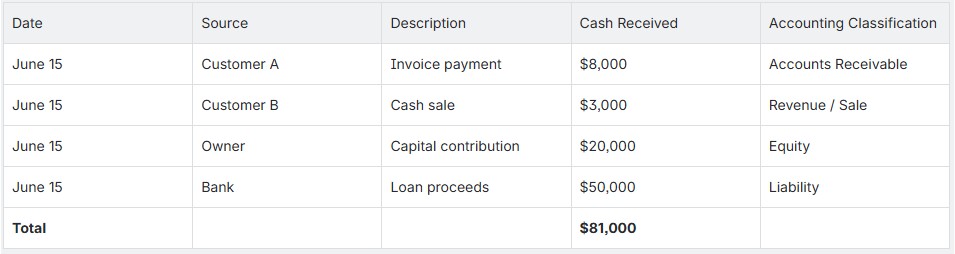
This example demonstrates the core purpose of a Cash Receipts Journal:
Record the Cash received and identify the accounting reason for each receipt.
The distinction is important for accurate Accounts Receivable, Revenue, Cash Flow, Balance Sheet, and Income Statement reporting.
Accurately recording Cash receipts requires more than simply recording the amount deposited into a bank account.
The business must also identify who paid, why the payment was received, and which accounting records should be affected.
Common challenges include:
For example, suppose a business receives a:
$15,000 bank deposit
and records the entire amount as Revenue.
Later, the accounting team determines that the deposit actually consisted of:
$10,000 customer Invoice payment
and:
$5,000 owner contribution
The original classification would be incorrect.
The customer payment should generally reduce Accounts Receivable, while the owner contribution would generally affect the appropriate Equity account.
Accurately identifying the source of Cash receipts is therefore essential for reliable financial reporting.
Cash receipts can affect several parts of a company's accounting records depending on the source of the payment.
When customers pay outstanding invoices, the payment generally reduces Accounts Receivable.
If the payment is not applied correctly, the customer's Invoice may continue to appear Open even though Cash has already been received.
This can affect:
Incoming payments increase Cash when properly received and recorded.
Accurate Cash records are important for:
Some Cash receipts may relate to Revenue, but others do not.
A customer collection against previously recognized Revenue generally reduces Accounts Receivable rather than creating Revenue again.
This distinction helps prevent Revenue from being overstated.
Borrowed funds can increase Cash while also increasing Liabilities.
Owner contributions can increase Cash and generally affect the appropriate Equity account.
The accounting impact of a Cash receipt therefore depends on the underlying transaction.
A Cash receipt is an individual transaction in which a business receives money.
A Cash Receipts Journal is the accounting record traditionally used to organize and record multiple Cash receipt transactions.
For example:
Customer pays $2,500 → Cash receipt
Recording that payment with other incoming payments in the specialized accounting record → Cash Receipts Journal
In modern accounting software, businesses may record the individual receipt through a customer-payment, sales, banking, or other transaction workflow rather than manually entering it into a separate journal.
The software can then update the appropriate accounting records based on the transaction.
The terminology may therefore reflect a traditional bookkeeping process even when the underlying accounting is now automated through software.
Traditional accounting systems may use separate specialized journals for incoming and outgoing Cash transactions.
A Cash Receipts Journal records transactions involving Cash coming into the business.
Examples include:
A Cash Disbursements Journal records transactions involving Cash leaving the business.
Examples can include:
Cash Receipts Journal → Money coming into the business
Cash Disbursements Journal → Money going out of the business
Together, these records traditionally helped businesses organize Cash transactions before amounts were posted to the General Ledger.
Modern accounting systems may handle both processes through integrated payment, banking, Accounts Receivable, Accounts Payable, and General Ledger workflows rather than separate manual journals.
A Cash Receipts Journal is a specialized journal, while the General Journal is traditionally used for transactions that are not handled through specialized journals or that require direct Journal Entries.
Used specifically for incoming Cash transactions.
Examples:
Traditionally used for transactions and adjustments such as:
Cash Receipts Journal → Specialized record for incoming Cash
General Journal → Broader journal used for applicable accounting entries and adjustments
Both ultimately contribute information to the company's accounting records and General Ledger.
In modern accounting software, users may not interact with these journals exactly as they would in a manual bookkeeping system.
Transactions entered through operational workflows can generate the required accounting effects automatically.
For businesses that sell on credit, Cash receipt processing is closely connected to Accounts Receivable.
A simplified transaction flow is:
Sale → Invoice → Accounts Receivable → Customer Payment → Cash
The business sells goods or services to the customer.
An Invoice documents the amount the customer owes and applicable Payment Terms.
When applicable, the outstanding amount becomes part of Accounts Receivable.
The customer may pay using methods such as:
The customer may also provide Remittance Advice identifying which Invoice or invoices the payment covers.
The business applies the payment to the appropriate customer and Invoice.
For example:
Outstanding Invoice:
$12,000
Customer payment:
$12,000
Simplified effect:
Cash +$12,000
Accounts Receivable −$12,000
If the Invoice has been paid in full and no unresolved balance remains, it is no longer an Open Invoice.
The payment can affect:
This is why accurate Cash receipt processing is an important part of Accounts Receivable management.
Recording a Cash receipt in the accounting system and seeing the corresponding transaction at the bank are related but distinct parts of the accounting process.
Suppose the accounting system records customer payments totaling:
$25,000
The business then deposits or receives those funds into its bank account.
During Reconciliation, the company compares its accounting records with bank activity to confirm that transactions are properly recorded and identify differences requiring investigation.
Potential differences may result from:
For example, the accounting system may show:
Cash receipts recorded: $25,000
while the bank activity initially shows:
Deposits: $20,000
The business should investigate the $5,000 difference rather than automatically adjusting one side to match the other.
The difference could simply represent timing, or it could indicate a recording problem.
Regular Reconciliation helps businesses confirm that recorded Cash activity is supported by external bank information.
Modern accounting and ERP systems can reduce the need to maintain a separate manual Cash Receipts Journal by capturing incoming payments through connected transaction workflows.
Depending on system capabilities, software can help businesses:
Integrated systems can also connect Cash receipts with the transactions that created them.
For example:
Customer → Sales Order → Invoice → Accounts Receivable → Payment → Cash → Reconciliation → General Ledger
This provides more context than recording a bank deposit without knowing which customer, Invoice, or transaction generated the payment.
CustomBooks connects sales, customer invoicing, Accounts Receivable, payments, banking, accounting, and other operational activity.
This connected approach can help businesses maintain clearer transaction histories and greater visibility into the movement from customer sale to payment and accounting records.
To better understand Cash Receipts Journals and how incoming payments move through accounting records, these related glossary terms may also be helpful:
A Cash Receipts Journal is a specialized accounting journal traditionally used to record incoming Cash transactions.
These can include customer payments, cash sales, owner contributions, loan proceeds, and other receipts.
A Cash Receipts Journal may record information such as:
The exact format depends on the bookkeeping or accounting system.
No.
A Cash receipt means money has been received, but the source determines the accounting treatment.
For example:
Customer payment on an existing Invoice → Cash increases and Accounts Receivable decreases
Loan proceeds → Cash increases and Liabilities increase
Owner contribution → Cash increases and the appropriate Equity account generally increases
A Cash sale may involve Revenue recognition, subject to the applicable accounting requirements.
A Cash Receipts Journal records incoming Cash.
A Cash Disbursements Journal records outgoing Cash.
Both are traditional specialized accounting journals.
The accounting concept remains relevant, but many businesses no longer maintain a separate manual Cash Receipts Journal.
Modern accounting and ERP systems can capture payments through customer, sales, Accounts Receivable, banking, and other workflows and update the appropriate accounting records automatically.
Receiving a payment is only one step in the customer transaction cycle.
Businesses also need to know:
For product-based businesses, that connected process can extend from the original sale through the final accounting record:
Sale → Invoice → Accounts Receivable → Payment → Cash → Reconciliation → General Ledger
When sales, invoicing, payments, banking, and accounting are disconnected, businesses may spend additional time tracing transactions and correcting mismatched records.
CustomBooks connects accounting with sales, customer invoicing, Accounts Receivable, payments, banking, and other operational activity, helping businesses maintain greater visibility across the transaction lifecycle.
Schedule a CustomBooks demo to see how connected accounting and operational workflows can help simplify financial management.


