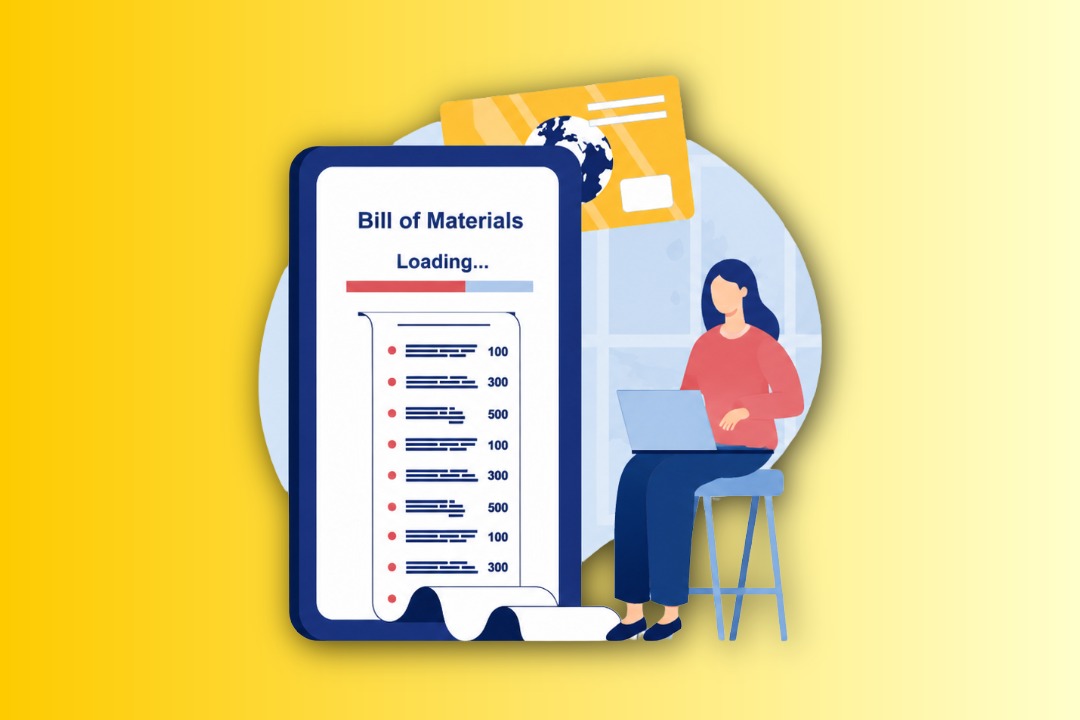
A Bill of Materials (BOM) acts as the blueprint for manufacturing. It defines every component, raw material, and subassembly required to produce a finished product.
While simple products may only require a single-level BOM, growing manufacturers often manage hundreds or thousands of products with multiple levels of assemblies. As complexity increases, spreadsheets and disconnected systems become difficult to maintain.
The problem usually is not creating the first BOM. The problem is keeping BOMs accurate as products, suppliers, materials, and production steps change.
Without proper BOM management, businesses may encounter inventory shortages, inaccurate product costing, purchasing mistakes, and production delays.
Key takeaways:
✓ Multi-level BOMs require visibility: Manufacturers need clear visibility into assemblies, subassemblies, and raw materials to avoid production delays.
✓ BOM accuracy affects inventory: Incorrect BOM structures often result in inventory discrepancies and purchasing errors.
✓ Product costing depends on BOM integrity: Accurate material tracking improves cost calculations and profitability analysis.
✓ Engineering changes must be controlled: Without revision management, production teams may use outdated components or specifications.
✓ Connected systems improve efficiency: Integrated manufacturing and accounting systems reduce manual tracking and improve operational visibility.
Accurate Bills of Materials help ensure production teams have the right materials, quantities, and assemblies available when needed.
Well-managed BOMs improve costing accuracy by connecting materials, assemblies, and inventory usage to finished products.
Many manufacturers initially manage BOMs using spreadsheets. While workable for small operations, spreadsheets become difficult to maintain as product catalogs expand.
Product designs change frequently.
When BOM updates are not communicated properly:
Without accurate BOM structures, manufacturers struggle to understand:
Step 1: Standardize Product Structures
Create consistent BOM naming conventions and hierarchy structures.
Step 2: Establish Revision Controls
Track engineering changes and maintain version history.
Step 3: Connect Inventory Data
Link BOMs directly to inventory records.
Step 4: Automate Material Planning
Use demand forecasts to determine future material requirements.
Step 5: Integrate Financial Reporting
Connect BOM costs to accounting and profitability reporting.
Better Production Planning: Production teams can accurately determine material requirements before work begins.
Improved Purchasing: Purchasing departments gain visibility into future component demand.
Reduced Stockouts: Inventory requirements become easier to forecast.
More Accurate Costing: Material costs flow more accurately into finished goods calculations.
Operational Scalability: Manufacturers can support larger product catalogs without proportional administrative growth.
Modern manufacturing systems provide centralized BOM management capabilities that improve accuracy and visibility.
Manufacturers can maintain multi-level BOM structures, track revisions, connect inventory records, automate purchasing recommendations, and improve production planning.
CustomBooks supports multi-level bill of materials structures while connecting inventory, purchasing, manufacturing workflows, and accounting into a single platform.
Consider a company that manufactures personal care products and sells through Shopify, Amazon, and wholesale distributors.
Initially, product formulas, ingredient lists, and production requirements were tracked using spreadsheets. This worked when the company offered only a few products and managed small production runs.
As the business expanded, challenges began to emerge:
The business eventually moved BOM management into a connected system that linked inventory, purchasing, production, and accounting.
The result was improved inventory visibility, more consistent production planning, and less time spent maintaining spreadsheets.
The lesson is simple: the larger the product catalog becomes, the more important it is to manage Bills of Materials as part of a connected operational process rather than a standalone spreadsheet.
Many businesses view Bills of Materials as a manufacturing requirement. In reality, BOMs influence nearly every part of the business.
They affect purchasing decisions, inventory planning, production scheduling, product costing, profitability analysis, and customer fulfillment.
As operations become more complex, maintaining BOM accuracy becomes increasingly important. Businesses that invest in stronger BOM management often gain better visibility across the organization and create a stronger foundation for future growth.
Whether you're managing ten products or thousands of SKUs, accurate BOM structures help ensure that inventory, production, and financial reporting remain aligned as the business scales.
A Bill of Materials is a structured list of materials, components, and subassemblies required to manufacture a finished product.
A multi-level BOM includes assemblies within assemblies, creating parent-child relationships between components.
They help manufacturers manage inventory, purchasing, production planning, and product costing.
Yes. Incorrect BOM structures can result in inaccurate product costs and poor pricing decisions.
Software centralizes BOM data, improves revision control, and connects manufacturing processes with inventory and accounting systems.
This approach is particularly valuable for:
Ready to Improve Manufacturing Visibility?
Managing complex BOM structures becomes increasingly difficult as product catalogs and production volumes grow.
CustomBooks helps manufacturers connect inventory, production, purchasing, and accounting processes into a single platform designed to support operational growth.